

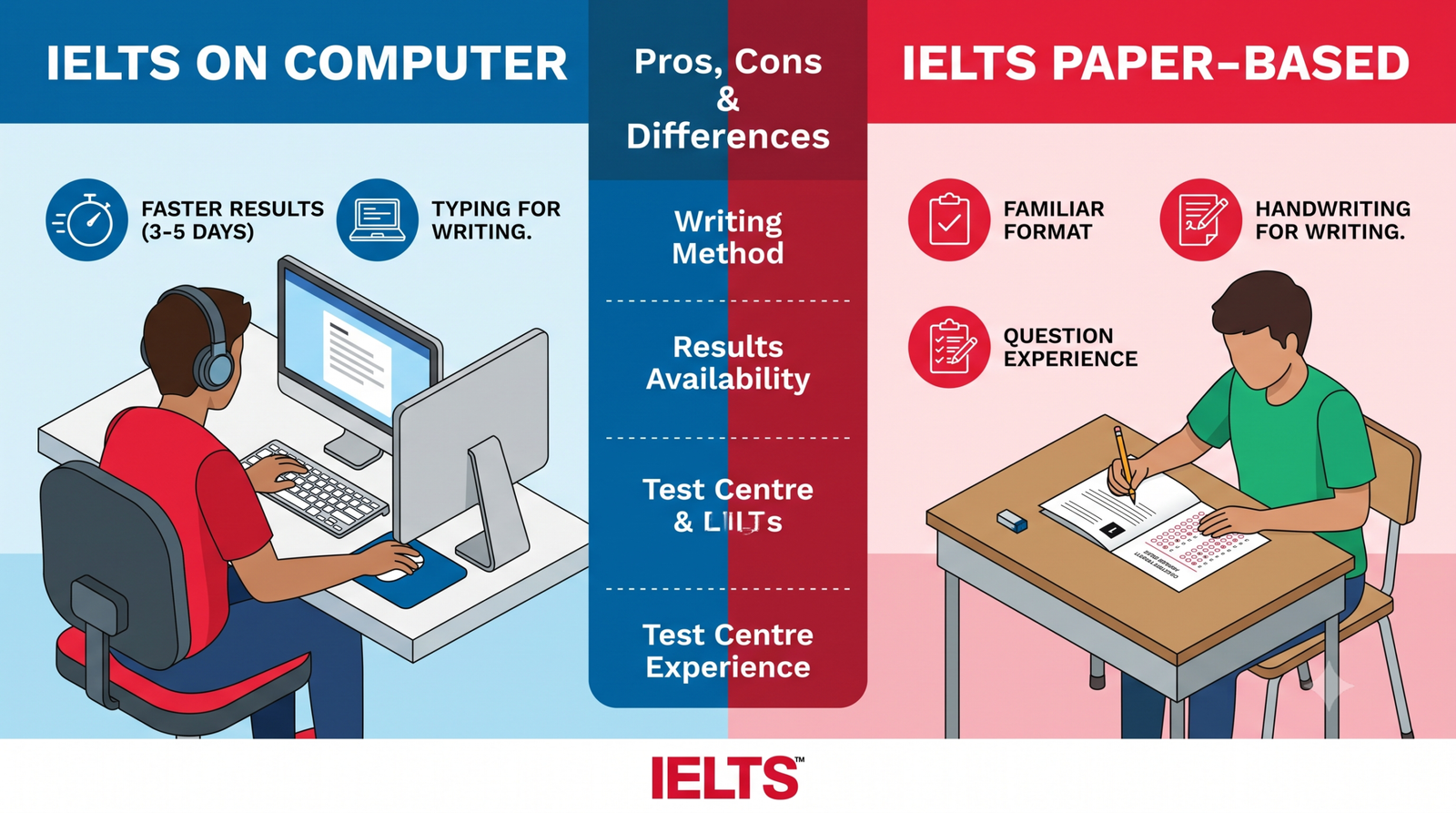
IELTS on computer and paper-based IELTS test the same skills, use the same questions and the same 1 to 9 band scale. The real differences are practical: how you answer, how fast you get results and how often you can book a date. For most people, the computer version is the faster, more flexible choice. Paper suits candidates who think best with a pencil in hand.
There’s one big update to know first. On 5 March 2026, the IELTS partners (British Council, IDP and Cambridge) announced that “from mid-2026, we will no longer offer IELTS as a paper-based test.” Exact timelines vary by country. In selected markets, a new option called Writing on Paper lets you handwrite the Writing section while doing Listening and Reading on screen.
So if you’re comparing formats today, your choice may already be narrower than older guides suggest. This article covers how the two formats differ section by section, the honest pros and cons of each, and how to decide what to book where you live.
Who this is for: students, skilled workers and migrants preparing for IELTS Academic or General Training who want to pick the format that gives them the best shot at their target band.
What stays the same in both formats
Before looking at differences, it helps to know what doesn’t change. This is where a lot of test-day anxiety comes from, so let’s clear it up.
- Content and difficulty. The question types, passage lengths and task types are identical. Neither version is designed to be easier.
- Scoring. Examiners mark Writing and Speaking against the same public band descriptors. Listening and Reading use the same raw-score-to-band conversion.
- Recognition. Universities, employers and immigration bodies treat both results the same way. Your Test Report Form doesn’t carry a penalty for format.
- Speaking. In both versions, Speaking is a live, face-to-face conversation with a certified examiner. It lasts 11 to 14 minutes. You never speak into a microphone to a machine.
- Section timings. Listening is about 30 minutes, Reading is 60 minutes and Writing is 60 minutes in both formats.
The IELTS partners stressed this point in their 2026 update: the switch to computer delivery does “not change the IELTS skills assessed, the test construct, or the way results should be interpreted.”
In other words, you’re choosing a delivery method, not a different exam. That reframes the question. Instead of asking “which one is easier?”, ask “which one lets me show my English at its best?”
Key differences between IELTS on computer and paper-based IELTS
| Factor | IELTS on computer | Paper-based IELTS |
|---|---|---|
| How you answer | Type on a keyboard, click to select options | Pencil on an answer sheet |
| Results | Typically 1 to 2 days (IDP), up to about 5 | About 13 days |
| Listening transfer time | None, plus 2 minutes to review | 10 minutes to copy answers onto the sheet |
| Reading tools | Highlight text, add notes on screen | Underline and annotate the question paper |
| Word count (Writing) | Automatic counter on screen | You count by hand |
| Audio | Personal headphones with volume control | Usually speakers in the room (varies by centre) |
| Test dates | Many sessions a week at most centres | Fewer fixed dates, mostly weekends |
| Speaking | Face-to-face, often same day | Face-to-face, same day or within a week |
| One Skill Retake | Available at participating centres | Not available |
| Availability (late 2026) | Standard worldwide | Being phased out from mid-2026 |
Listening
This is the biggest practical difference. On paper, you write answers on the question booklet as you listen, then get 10 minutes at the end to transfer them to the answer sheet. On computer, you type answers directly into the boxes while the audio plays. There’s no transfer time, only a short 2-minute review.
That sounds like a disadvantage, but many candidates find it easier. You skip the risk of copying errors, and spelling mistakes are easier to spot on a clean screen. Personal headphones also cut out room echo and the person coughing next to you.
Reading
On screen, the passage sits on one side and the questions on the other. You can highlight key phrases and add notes. On paper, you can flip pages, circle words and scribble freely in the margins.
If you read long texts on a screen every day for work or study, computer Reading will feel natural. If you rely on physically marking up text, paper may feel more comfortable. Some candidates report mild eye strain after 60 minutes of on-screen reading, which is worth testing during practice.
Writing
Typing is faster for most people who use a keyboard daily. You can delete, move sentences and fix errors without crossing out. The automatic word counter removes the worry about falling short of 150 or 250 words.
Handwriting has its own advantages. You won’t lose time fighting an unfamiliar keyboard layout, and some writers plan better on paper. The downside: messy handwriting can make an examiner’s job harder, and editing a finished paragraph is clumsy.
Note that spelling still counts on the computer test. There’s no spellcheck or autocorrect.
Speaking
No difference in format. Both versions use a live examiner and the same three-part structure. The main variation is scheduling. Computer test centres often book Speaking on the same day as the other sections.
Pros and cons of IELTS on computer
Pros
- Faster results. Results usually arrive within 1 to 2 days. That matters when a university deadline or visa appointment is close.
- More test dates. Computer centres run multiple sessions a week, often including weekdays. You can book closer to your preferred date and sometimes at short notice.
- Easier editing in Writing. You can cut, rewrite and reorganise without a messy page.
- Built-in word count. One less thing to track under time pressure.
- Clearer Listening audio. Personal headphones and volume control help if you’re easily distracted.
- Smaller, quieter rooms. Computer sessions usually have fewer candidates than large paper halls.
- One Skill Retake. If you miss your target in one section, you can retake just that skill within 60 days instead of the whole test (at participating centres).
Cons
- No Listening transfer time. You must type clean, correctly spelled answers in real time.
- Screen fatigue. Reading long passages on screen can be tiring if you’re not used to it.
- Keyboard unfamiliarity. A different layout (for example, if you normally type in a non-English script) can slow you down.
- Less freedom to annotate. Highlighting and notes are useful but more limited than free scribbling.
- Technical hiccups. Rare, but a frozen screen or audio glitch can rattle you, even though invigilators can step in.
One practical tip: if your typing speed is under about 30 words per minute, practise timed writing on a keyboard for a few weeks before booking. Task 2 asks for at least 250 words in roughly 40 minutes, and slow typing eats into planning time.
Pros and cons of paper-based IELTS
Pros
- Familiar for traditional learners. If you studied with printed workbooks and handwrote your practice essays, paper matches how you prepared.
- 10 minutes of Listening transfer time. You can jot rough answers during the audio and tidy them up at the end.
- Free annotation. Circle, underline, draw arrows and number paragraphs however you like.
- No screen strain. Better for candidates who get tired or distracted reading on a monitor.
- No typing pressure. Useful if you type slowly or rarely use an English keyboard.
Cons
- Slower results. About 13 days, which can be tight against admission or visa deadlines.
- Fewer dates. Paper sessions run on fixed dates, usually a few times a month.
- Manual word counting. Easy to waste minutes counting or to misjudge length.
- Handwriting risk. Unclear letters can cost you in spelling-sensitive Listening and Reading answers.
- Larger, noisier halls. Speaker-based Listening in a big room isn’t ideal for everyone.
- No One Skill Retake. A weak section means resitting the full test.
- Shrinking availability. Following the March 2026 announcement, paper-based IELTS is being withdrawn market by market. In many places, it’s no longer bookable at all.
What about Writing on Paper?
Writing on Paper is the compromise the IELTS partners introduced for 2026. You take Listening and Reading on computer, then handwrite your Writing tasks. It keeps the fast results and frequent dates of computer delivery while letting you write by hand.
Two things to note. First, it’s only offered in selected markets. Second, if you take Writing on Paper and later use One Skill Retake, the retake must also be Writing on Paper. The UK Visas and Immigration version (IELTS for UKVI SELT) is fully digital only, so this option isn’t available for UK visa applicants.
How to choose the right IELTS format for you
Start with what’s actually available. Check your nearest British Council or IDP centre before you plan around a format, because paper may already be gone where you live. Then match the format to your habits.
| If you… | Best fit | Why |
|---|---|---|
| Type comfortably at 35+ words per minute | IELTS on computer | Faster Writing, easy edits, auto word count |
| Need results within a week | IELTS on computer | Results in about 1 to 2 days |
| Might need to resit one weak section | IELTS on computer | One Skill Retake saves time and money |
| Write faster by hand and rarely type in English | Writing on Paper (or paper, if still offered) | Handwrite the essay, keep fast results |
| Get distracted in big halls | IELTS on computer | Smaller rooms, personal headphones |
| Struggle with reading long texts on screens | Paper, if still offered | Read and annotate on printed pages |
| Are applying for a UK visa | IELTS for UKVI on computer | SELT is fully digital only |
A simple test before you book
Don’t decide on gut feeling. Try this over one weekend:
- Take a full Listening and Reading practice test using the official computer-delivered familiarisation tests on the IELTS, IDP or British Council websites.
- Take a second practice test on printed paper with a timer.
- Write one Task 2 essay by hand and one on a keyboard, each in 40 minutes.
- Compare your scores, your word counts and how tired you felt.
If your results are within half a band of each other, pick the computer test for the speed and scheduling benefits. If one format is clearly stronger, book that one (where available).
Preparation tips for the computer test
- Practise typing answers while audio plays, so there’s no transfer-time habit to break.
- Get used to scrolling passages and using highlight tools.
- Proofread for spelling. There’s no autocorrect.
- Learn to keep an eye on the on-screen timer without panicking.
- Use the scratch paper you’re given to plan essays before typing.
Frequently asked questions
Is IELTS on computer easier than paper-based IELTS?
A. No. The questions, difficulty and marking are the same. Some candidates score higher on computer because they type faster or concentrate better with headphones, but that’s about fit, not difficulty.
Is the paper-based IELTS being discontinued?
A. Yes, in most markets. The IELTS partners announced in March 2026 that paper-based IELTS would end from mid-2026, with timelines varying by country. Selected markets offer Writing on Paper instead.
Is my old paper-based IELTS result still valid?
A. Yes. Paper-based results remain valid for the usual recognition period, typically two years, set by the organisation you’re applying to.
Is the Speaking test done on a computer?
A. No. Speaking is always a face-to-face conversation with a human examiner, in both formats.
How fast are IELTS on computer results?
A. Usually 1 to 2 days, though some centres quote up to 5 days. Paper-based results took about 13 days.
Can I use spellcheck on the computer test?
A. No. Spellcheck and autocorrect are switched off, so spelling accuracy still counts
Key takeaways
IELTS on computer and paper-based IELTS measure the same English skills with the same scoring. The computer version wins on result speed, date flexibility, Writing edits and One Skill Retake. Paper suited handwriters and print readers, but it’s being phased out from mid-2026, with Writing on Paper as the main alternative in selected markets.
Check what your local centre offers, run a quick practice comparison, then book the format that lets you perform at your best.