

Picking the wrong IELTS test is an expensive mistake. You pay the full fee, spend weeks preparing, and then find out the university or immigration office you applied to won’t accept your result.
The good news is that the choice is usually simple once you know what each test is for.
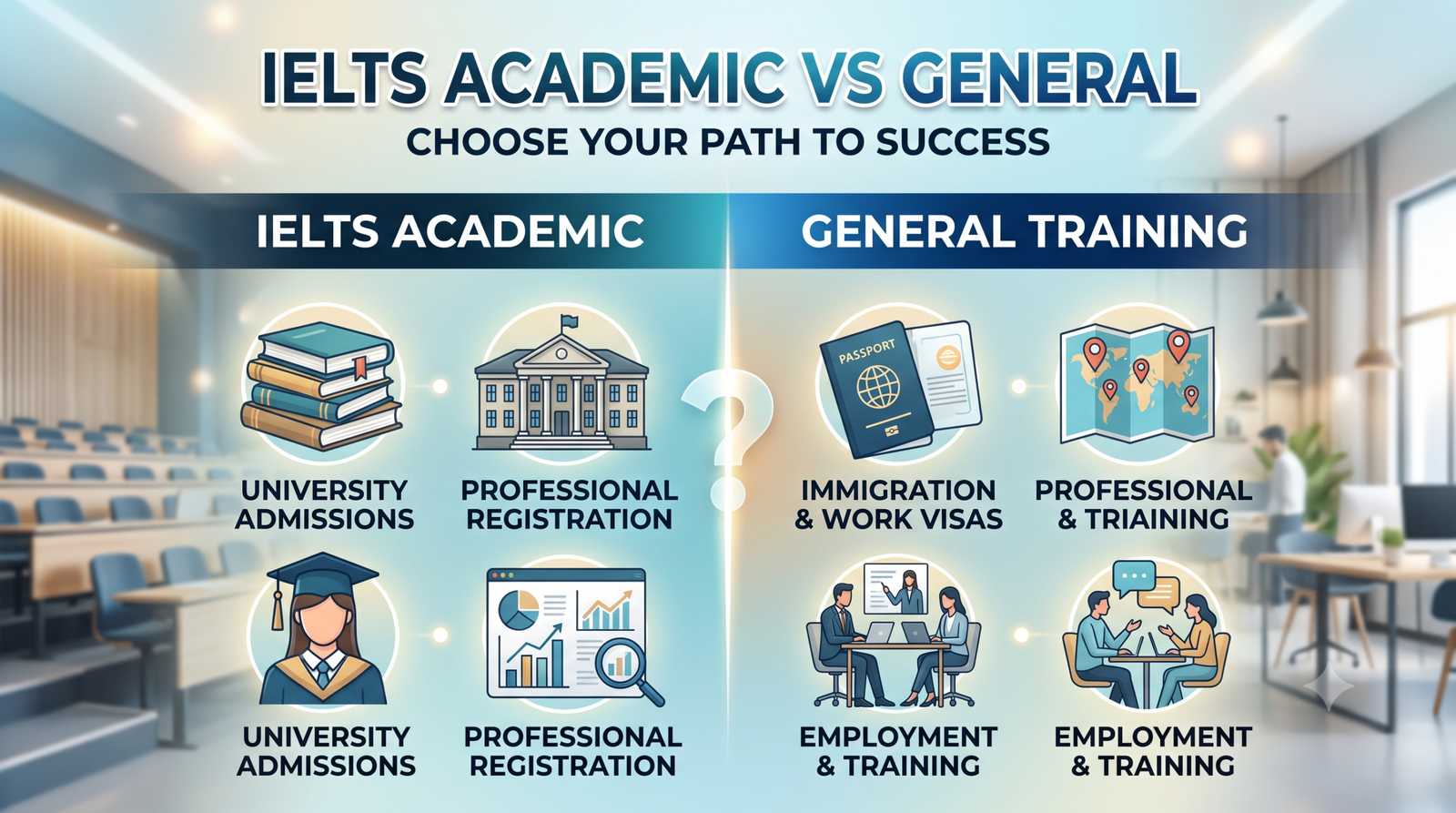
The short answer: Take IELTS Academic if you plan to study at a university or college, or need to register with a professional body like a nursing or medical council. Take IELTS General Training if you’re moving abroad for work, permanent residence, or secondary education. When in doubt, the organisation you’re applying to decides, not you. Always check its exact requirement first.
This guide explains how the two tests differ, how scoring works, which one fits common goals, and how to prepare for each.
What Is the Difference Between IELTS Academic and General Training?
Both tests measure your English in four skills: Listening, Reading, Writing, and Speaking. Both use the same 0 to 9 band score scale, and the total test time is about 2 hours and 45 minutes for each.
The difference lies in the kind of English each one checks.
- IELTS Academic tests whether you can handle English in a university setting. You’ll read texts that look like they came from textbooks and journals, and you’ll describe charts and data in writing.
- IELTS General Training tests whether you can handle English in daily life and at work. You’ll read notices, ads, workplace documents, and general articles, and you’ll write a letter.
Think of it this way. Academic asks, “Can you follow a lecture and write a research-style essay?” General Training asks, “Can you understand your lease, read an email from your manager, and write to your landlord?”
Section-by-Section Comparison
Two of the four sections are identical. The other two are where the tests split.
| Section | IELTS Academic | IELTS General Training |
|---|---|---|
| Listening (about 30 minutes) | Same test | Same test |
| Reading (60 minutes) | 3 long academic texts | Everyday and workplace texts, plus one longer article |
| Writing (60 minutes) | Task 1: describe a graph, chart, or diagram. Task 2: essay | Task 1: write a letter. Task 2: essay |
| Speaking (11 to 14 minutes) | Same test | Same test |
Listening: Same for Both
You’ll hear four recordings and answer 40 questions. The recordings include everyday conversations and a short academic-style talk. On a paper-based test, you get extra time at the end to transfer your answers. On the computer-delivered test, you type as you go.
Speaking: Same for Both
This is a face-to-face conversation with a certified examiner, in three parts. You’ll talk about yourself, speak on a topic for one to two minutes, and then discuss broader ideas linked to that topic.
Reading: The First Big Difference
Both Reading tests have 40 questions in 60 minutes. The texts are what change.
Academic Reading includes three long passages taken from books, journals, magazines, and newspapers. Topics are general interest but written in an academic tone. Some passages include diagrams or technical terms. You’ll often need to follow an argument or identify a writer’s opinion.
General Training Reading is split into three sections that get harder as you go:
- Short everyday texts, such as notices, timetables, and advertisements
- Workplace texts, such as job descriptions, contracts, and training material
- One longer, more complex text on a general topic
Many test takers find the General Training texts easier to understand. That doesn’t make it the easier test overall, as you’ll see in the scoring section below.
Writing: The Second Big Difference
Both Writing tests have two tasks in 60 minutes. Task 2 is similar in both, but Task 1 is very different.
Academic Writing Task 1 asks you to describe visual information in at least 150 words. You might get a line graph, bar chart, table, pie chart, process diagram, or map. You need to summarise key trends and make comparisons without adding your own opinion.
For example, you might see a chart showing how three countries’ energy use changed from 2000 to 2020. You’d point out the main trends, the biggest changes, and any notable comparisons.
General Training Writing Task 1 asks you to write a letter of at least 150 words. The prompt tells you who you’re writing to and what to cover. The tone can be formal, semi-formal, or informal.
For example, you might write to a hotel manager about a problem during your stay, explaining what happened and what you’d like them to do.
Task 2 in both tests is an essay of at least 250 words. You’ll respond to an opinion, argument, or problem. Academic essay topics tend to be slightly more abstract. General Training topics are often closer to everyday issues. Task 2 carries more weight than Task 1 in your Writing score, so plan your time with that in mind.
How Scoring Works (and Why “Easier” Is Misleading)
Both tests give you a band score from 0 to 9 for each skill, plus an overall band score. The overall score is the average of the four, rounded to the nearest half band.
Listening and Speaking are scored the same way for both tests. Writing is marked against the same four criteria: task achievement or response, coherence and cohesion, vocabulary, and grammar.
Reading is where the scoring differs. Because General Training reading texts are generally more accessible, you need to answer more questions correctly to earn the same band score.
As a rough guide, a band 6 in Academic Reading might need around 23 correct answers out of 40, while General Training might need around 30. The exact conversion varies slightly between test versions, so use these numbers only as a ballpark.
So General Training isn’t a shortcut. The texts are simpler, but the bar is higher. Choose the test based on what your goal requires, not on which one looks easier.
Which IELTS Test Should You Take? Common Scenarios
Here’s how the choice usually plays out for the most common goals.
Studying at a University or College
Take IELTS Academic. This applies to undergraduate and postgraduate programs in the UK, Canada, Australia, New Zealand, the US, Ireland, and most other countries. Almost all universities ask for Academic.
If you need a student visa for the UK, check whether your university requires the standard IELTS or IELTS for UKVI (Academic). Many UK universities accept the standard test for degree-level courses, but courses below degree level often need the UKVI version.
Professional Registration (Doctors, Nurses, and Other Professionals)
Usually IELTS Academic. Regulators for doctors, nurses, pharmacists, and other healthcare roles in countries like the UK, Australia, and New Zealand typically ask for Academic, often with high minimum scores in each skill. Some also accept other tests, such as OET. Rules differ by country and profession, so check your regulator’s current requirements before booking.
Moving to Canada for Permanent Residence
Take IELTS General Training. For economic immigration programs such as Express Entry, Immigration, Refugees and Citizenship Canada (IRCC) accepts IELTS General Training, not Academic. Your band scores are converted into Canadian Language Benchmark (CLB) levels, which can make a big difference to your points.
If you’re going to Canada to study, the student permit process and your college will usually ask for Academic instead.
Skilled Migration to Australia or New Zealand
Usually either works, but check. Australia’s Department of Home Affairs accepts both Academic and General Training for many visa types. However, if you also need a skills assessment or professional registration, that body may insist on Academic. Aligning with the stricter requirement lets you use one test for both.
Working or Training Abroad
Usually IELTS General Training. Many work visas and employer programs use General Training to confirm you can function in an English-speaking workplace. Some employers in regulated fields may still ask for Academic.
Moving to the UK for Work, Family, or Settlement
It depends on the visa. UK Visas and Immigration uses approved Secure English Language Tests. Depending on your route, you may need IELTS for UKVI (General Training), IELTS for UKVI (Academic), or IELTS Life Skills, which only tests speaking and listening. Check the UK government’s guidance for your specific visa.
Secondary School or Non-Degree Training
Usually IELTS General Training. Schools, vocational courses, and training programs below degree level often accept General Training. Always confirm with the institution.
Quick Decision Table
| Your Goal | Test to Take |
|---|---|
| University degree (UG or PG) | Academic |
| Doctor, nurse, or professional registration | Usually Academic |
| Canada permanent residence (Express Entry) | General Training |
| Canada study permit | Academic |
| Australia skilled migration | Either (check skills assessment body) |
| Work visa or job abroad | Usually General Training |
| UK visa | Depends on route (UKVI version may be required) |
| Secondary school or vocational training | Usually General Training |
Can You Switch Between Tests?
Not after you’ve taken one. Your result is issued for the specific test you sat, and it can’t be converted. If you took General Training and later need Academic for a university, you’ll have to book and pay for a new test.
That’s why checking requirements before booking matters. If you’re considering both study and migration in the next two years, it may make sense to take Academic if every organisation on your list accepts it. Just confirm this first, because Canada’s permanent residence programs are an example where Academic is not accepted.
Most organisations treat IELTS results as valid for two years from the test date. Some set their own limits, so check that too.
How to Prepare for Each Test
Your preparation should focus on the sections that differ. Listening and Speaking practice works for both tests.
Preparing for IELTS Academic
- Practise describing visuals. Work through different chart types and learn phrases for trends (“rose sharply,” “remained stable,” “peaked at”). Focus on picking out the main features rather than listing every number.
- Build reading stamina. Academic passages are long and dense. Practise reading articles from sources like science magazines and quality newspapers, then summarise the main argument in a sentence or two.
- Learn academic vocabulary. Words for cause, effect, comparison, and contrast will help in both reading and writing.
Preparing for IELTS General Training
- Master the three letter tones. Know how to open and close formal, semi-formal, and informal letters, and practise matching your tone to the person you’re writing to.
- Cover all bullet points. Letter prompts give you three points to address. Missing one is a common reason for lower scores.
- Practise speed and accuracy. Since you need more correct answers for the same band, careless mistakes in the Reading section cost more. Practise scanning notices and workplace documents quickly for specific details.
Tips for Both Tests
- Take a full timed practice test early. It shows you where you stand and which sections need the most work.
- Use official practice material. Materials from IELTS, the British Council, IDP, and Cambridge are the closest to the real test.
- Get feedback on your writing. It’s hard to judge your own essays. A teacher or study partner can spot patterns you miss.
- Record yourself speaking. Listen back for hesitation, repetition, and gaps in vocabulary.
- Decide between paper and computer. Content and scoring are the same. Computer-delivered tests usually return results within a few days, and many people find typing faster than handwriting.
Booking Your Test
IELTS is jointly owned by the British Council, IDP, and Cambridge University Press & Assessment. In India, tests are booked through IDP. In many other countries, you can book through either the British Council or IDP.
When you book, you’ll choose:
- Academic or General Training
- Standard IELTS or IELTS for UKVI, if you need it for a UK visa
- Paper-based or computer-delivered
- Your test date and location
Fees vary by country and change from time to time. In India, the standard test has cost roughly ₹18,000 in recent years, but check the current fee on the official booking site before you plan your budget.
Frequently Asked Questions
Is IELTS General Training easier than Academic?
A. The reading texts and the letter task are usually easier to understand in General Training. However, you need more correct Reading answers to reach the same band. Most people find the overall difficulty roughly comparable.
Can I use IELTS General Training for university admission?
A. Rarely. Most universities require IELTS Academic for degree programs. Some colleges and non-degree courses may accept General Training, but confirm with the institution first.
Can I use IELTS Academic for Canada PR?
A. No. For Express Entry and other economic immigration programs, IRCC accepts IELTS General Training, along with some other approved tests. Academic is not accepted for these programs.
Are the Listening and Speaking tests really the same?
A. Yes. Both tests share the same Listening and Speaking sections, and they are scored the same way.
How long is an IELTS score valid?
A. Most organisations accept scores for two years from the test date. Some immigration programs and universities set their own rules.
What score do I need?
A. It depends entirely on your goal. Universities often ask for an overall 6.0 to 7.0, while professional registration and some migration routes may require 7.0 or higher in every skill. Check the exact scores your target organisation asks for.
Choosing the Right IELTS Test
The IELTS Academic vs General Training decision comes down to one question: what does the organisation receiving your score require? For university study and most professional registration, that’s usually Academic. For migration, work, and non-degree training, it’s usually General Training.
Before you book, find the official language requirement page for your university, regulator, or visa program. Note the test type, the minimum overall score, and any minimum per skill. Then build your preparation around the sections where the two tests differ. A few minutes of checking up front can save you a second exam fee and several weeks of waiting.